
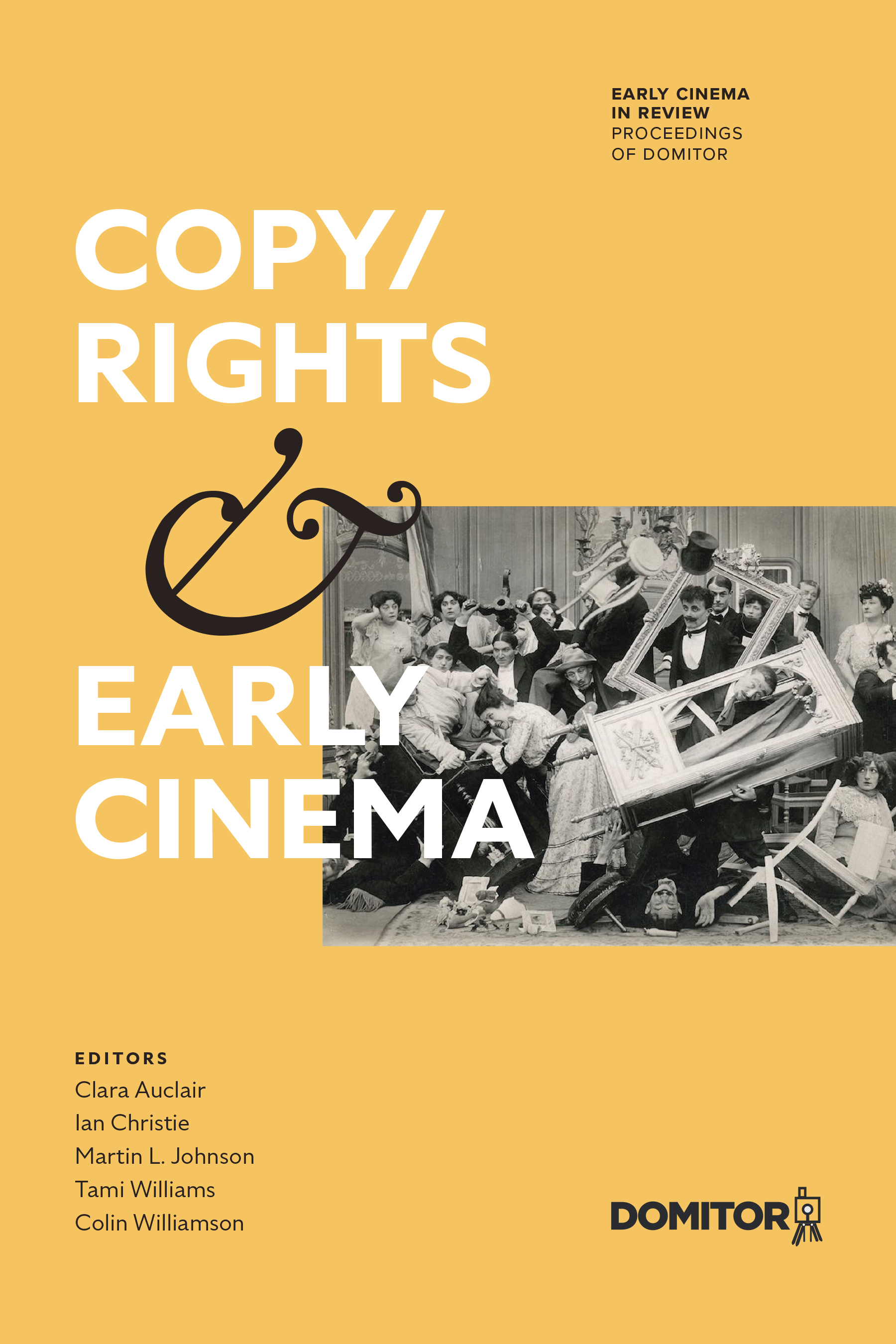
Copy/Rights and Early Cinema

Proceedings of the 17th International Domitor Conference

Subjects: Social Science, Media Studies, Performing Arts, History & Criticism
Imprint: Lever Press
Ebook : 9781643151106, 390 pages, 80 b-w images, 6 x 9, November 2026
Paperback : 9781643151090, 390 pages, 80 b-w images, 6 x 9, November 2026
See expanded detail +

Claiming and defending rights—legal, moral, and human—was central to the development of cinema

Table of contents

Acknowledgements

Introduction: On Copy/Rights and Early Cinema, Then and Now 

Part I: Copyright in Context

Chapter One: Product, Artwork, or Performance? Ongoing Issues in the Legal History of Film by Ian Christie

Chapter Two(A): Rights for Pathé Authors and Camera Operators (1909-1912) by Stéphanie Salmon

Chapter Two(B): Droits d'auteur, droits d'opérateurs chez Pathé (1909-1912) by Stéphanie Salmon

Chapter Three: The Shadow Line: A Making of by Claudy Op den Kamp

Chapter Four: The Coronation of Edward VII (1902): A Paradigm Shift by Joël Lehmann

Part II: Copyright and Early Intermediality

Chapter Five: The Case of Muybridge: A Photographer's Problem in Motion by Frank Ming

Chapter Six: Marey, Pettigrew, and the Wings of the Insect by Michael Cowen

Chapter Seven: ‘Pictures That Move and Ship That Fly’: ‘Professor’ W.F. Brinton and the Kinship Between Early Aviation and Early Cinema by Paula Amad

Chapter Eight: Early Cinema Sued by Painting by Valentine Robert

Part III: Piracy and Censorship

Chapter Nine: Fraud and Industrail Espionage: What Piracy Tells Us About Copyright in Motion Picture Technology That We Suspected All Along by Jane Gaines

Chapter Ten: Evil, Indecent, and Immoral Films: Colonial Censorship in the Philippines by Nadi Tofighian

Chapter Eleven: Pre-Censorship Regimes and Practices: Film Rights, Title Changes, and Piracy in Stockholm 1908-1911 by Marina Dahlquist

Chapter Twelve: Ottoman Cinema: Regulation and Censorship During the Hamidian Period by Özde Çeliktemel

Part IV: International Distribution

Chapter Thirteen: Across the Border, Around the Law: Copyright, Film Ontology, and the Late Johnson-Willard Fight Film by Dimitrios Latsis

Chapter Fourteen: The Right to Possess a Film Print and the Right to Screen It: An Exemplary Legal Case on the Brazilian Film Distribution Market in 1912 by Rafael de Luna Freire

Chapter Fifteen: Copyright in Times of Family Businesses: The Pathé and Gaumont Film Exhibition Contracts in the Correspondence Between the Ferrez Family and Achille Nevière (Brazil-Paris, 1914-1915) by Danielle Crepaldi Carvalho

Part V: Privacy and Rights to the Image

Chapter Sixteen: Re-Editing a Revolution: Charles Pryor and the Circulation of Films on the Mexican Revolution by Paolo Tosini

Chapter Seventeen: ‘Real True Pictures’: Filming The Battle of Cameron Dam for Politics and Profit by Martin L. Johnson

Chapter Eighteen: Re-Imagining Home Movie Footage as Cultural Memory: The Inter-Tribal Indian Ceremony, Gallup, New Mexico by Alison Griffiths

Chapter Nineteen: Copyright Challenges or Deceptive Marketing? Capitalizing on Quo Vadis? (1913) in Australia by Julie K. Allen

Part VI: Infamy and Defamation

Chapter Twenty: The Banned Superstar: Jesus Christ on Early Russian Screen by Anna Kovalova

Chapter Twenty-One: Sapho Kiss: Rethinking Edison v. Lubin by Kiki Loveday

Chapter Twenty-Two: Paramount, Société des Cinéroman, and Defamation in Fiction Film: Two French Court Decisions from the 1920s by Vassiliki Tsitsopoulou

Author Bibliographies

Description

Histories of early cinema often focus on technological, social, and aesthetic developments in the medium. But cinema also posed legal challenges throughout the world and continues to do so in the era of digital media and AI. The methods used to establish and defend copyright varied across national contexts and changed over time, shaping how films were circulated and preserved. This edited volume includes essays based on conference papers given at the 17th Domitor conference and includes case studies from a range of national, historical, and cultural contexts. 

The essays in this volume address an array of themes, including copyright and early intermediality, piracy and censorship, international distribution, infamy and defamation, and publicity, privacy, and rights to the image. Although these essays center the first decades of cinema, the rights they address continue to resonate today. Since intellectual property law is constantly struggling to stay abreast of technological innovation, this collection has special relevance in a new era of global production and digital technologies that is as momentous as the invention of cinema. Claiming, defining, and defending rights are returned to the spotlight as AI draws upon the past of cinema to shape its future.

Clara Auclair is Lecturer in European Humanities at DIS Stockholm.

Ian Christie is Professor Emeritus of Film and Media History at Birkbeck, University of London and a visiting tutor at the UK National Film and Television School (NFTS). 

Martin L. Johnson is Professor of English and Comparative Literature at the University of North Carolina at Chapel Hill. 

Tami Williams is Associate Professor of Film Studies and English at the University of Wisconsin-Milwaukee. 

Colin Williamson is Associate Professor of Cinema Studies at the University of Oregon. 

Read: Copy/Rights and Early Cinemafeature in Cinecitta News | October 6, 2026